Regulation. Safety. Engineering.
Plain language for the words that govern this category. Every regulatory term carries the live source link. Use it as a glossary, or as the single page you forward to your auditor before the next meeting.
Term
KRITIS-Dachgesetz
German federal umbrella act for critical infrastructure operators. Bundestag-Drucksache 20/9262, regulates physical-resilience obligations across energy, water, finance, health, transport, IT and food sectors.
Adopted to consolidate physical-security obligations that were previously scattered across sector-specific BSI ordinances. Operators of critical infrastructure must demonstrate state-of-the-art protective measures, register incidents within tight reporting windows, and submit to periodic audits.
For perimeter security, the act elevates autonomous detection and audit-defensible incident logs from a nice-to-have to a baseline expectation. Operators using only patrol staff or static cameras will struggle to evidence parity with the technical state of the art.
Term
NIS-2
EU Directive 2022/2555. Replaces NIS-1, expands the regulated perimeter, lifts fines to €10M or 2 percent of global turnover, and extends personal liability to management.
Article 21 mandates risk-management measures including physical security. Article 34 sets the corporate fine ceiling. National implementations (in Germany the NIS2UmsuCG) extend personal liability to management board members and require documented incident response.
For perimeter operations the directive forces a shift from procedural to evidence-based: every measure has to be demonstrable, every incident has to be retrievable, and the audit trail has to satisfy a regulator who has not seen the site.
Term
GDPR Art. 28 processor
Regulation 2016/679, Article 28. Defines the role and obligations of a data processor handling personal data on behalf of a controller.
Quarero acts as processor under Art. 28 for any imagery captured during patrol. Before deployment we sign a data-processing agreement with the customer, deliver a model DPIA aligned to the site, and provide signage templates for the affected zones.
Biometric identification is disabled by default. Recordings without an event are deleted within 48 to 72 hours. Defined zones can carry differing retention windows, and sensitive areas (changing rooms, medical zones) are masked automatically.
Term
EU AI Act
Regulation 2024/1689. Risk-tiered framework for AI systems. Autonomous security with biometric or anomaly detection falls under high-risk obligations from August 2026.
Article 13 requires transparency: every detection must come with a reasoning path that an operator can interpret. Black-box AI is not compliant for high-risk use cases.
Quarero ships with documented reasoning traces per detection — not just a confidence score, but the feature contributions and the policy that fired. This is what the August 2026 deadline actually requires, and what insurance and audit teams will ask for.
Term
CE Machinery Regulation 2023/1230
EU regulation replacing the 2006/42 Machinery Directive. Sets safety, risk-assessment and conformity requirements for machinery placed on the EU market.
Applies to autonomous mobile platforms including security robots. CE marking under this regulation is the entry-level proof that a machine has been risk-assessed and conforms to harmonised safety standards.
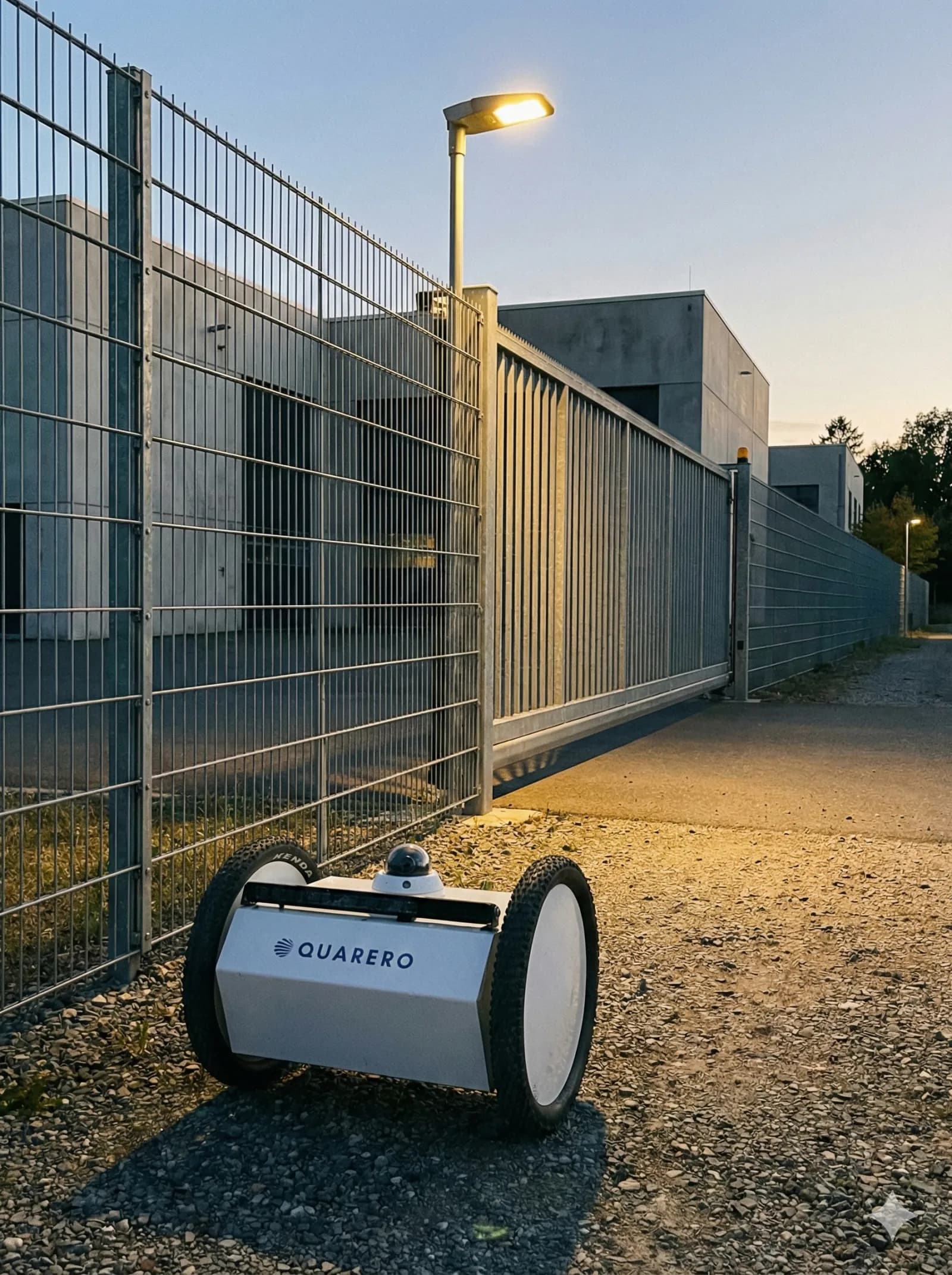
Quarero QR-2 Mk1 is CE-marked under the regulation, with the conformity-assessment file kept by Quarero Robotics Deutschland GmbH and available on regulator request.
Term
EN ISO 13482
Harmonised European safety standard for personal-care robots, including mobile servant and person-carrier categories. Used as the safety baseline for autonomous patrol platforms.
Defines hazards specific to robots that share space with people: collision risk, unexpected motion, hazardous power output, restart logic, emergency-stop reachability. Compliance is evidenced through risk assessment plus design-and-test records.
QR-2 inherits the safety architecture required by ISO 13482 — speed-limited drive, ultrasonic plus LiDAR collision envelope, automatic safety-stop on sensor failure, hardware emergency-stop reachable on the chassis.
Term
IP65
Ingress-protection rating. First digit 6: dust-tight. Second digit 5: protected against low-pressure water jets from any direction.
IP65 is the practical baseline for outdoor industrial machinery in DACH. It survives rain, wind-driven debris, hose-down cleaning at low pressure, and most weather conditions short of a high-pressure jet wash or full immersion.
QR-2 chassis is IP65-rated end-to-end. Sensor heads, compute enclosure and battery bay are individually sealed so a compromised seal never propagates.
Term
Edge AI
AI inference run on the device itself, not in the cloud. Cuts latency, removes a class of network failure modes, keeps sensitive imagery on-device.
QR-2 carries an edge GPU sized for real-time multi-stream sensor fusion. Detection happens in milliseconds without leaving the device. Only events of interest plus a thumbnail are uplinked over TLS 1.3.
This matters operationally because connectivity is the single most common failure surface for security systems in the field. An edge-AI device keeps detecting and recording even when the uplink is degraded.
Term
Robots-as-a-Service (RaaS)
Service-contract model for robotics. Customer pays a monthly flat that includes hardware, sensors, software, maintenance, spares and battery. No CapEx.
RaaS converts a fleet decision from a multi-year capex project into a procurement-style monthly line item. The provider keeps fleet ownership, refreshes hardware on its own schedule, and absorbs the obsolescence risk.
Quarero RaaS starts at €3,200 per month for QR-1 Basis, with a 24-month minimum. Discounts up to −20 percent combined volume plus term. Pilot clause 14 days at €0 risk built into every contract.
Term
DACH
Germany (DE), Austria (AT), Switzerland (CH). Three German-speaking markets treated as one commercial region.
Quarero operates as a DACH service. Engineering and operations sit in Filderstadt (DE). The holding sits in Zug (CH). Enquiries are handled directly across all three countries through one named contact — Marcus Köhnlein (Managing Director DACH).
Customers benefit from contract templates that already reconcile German, Austrian and Swiss data-protection regimes, and from a single named contact that does not hand off across borders.
Term
Perimeterschutz
Technische Absicherung der äußeren Grenze eines Geländes: Zaun, Mauer und freie Fläche zwischen Werkstor und Gebäude, abgesichert gegen unbefugtes Betreten, Sabotage, Diebstahl und Spionage.
Klassisch durch Wachpersonal, Zaundetektion und Kameras realisiert. Im Stand der Technik 2026 übernimmt autonome Robotik die kontinuierliche Patrouille; KI klassifiziert die Aufzeichnung in Echtzeit.
Die wirtschaftliche Schwelle für Robotik-gestützten Perimeterschutz liegt bei Außenflächen ab rund 5.000 qm. Darunter rechnet sich klassische Streife oder reine Sensorik in der Regel besser.
Term
Laufroboter
Robotik-Klasse mit Beinen statt Rädern. In der Sicherheitsbranche selten produktiv eingesetzt, weil Energieeffizienz, Wartung und Geländegängigkeit für Patrouillen-Aufgaben Radroboter unterlegen sind.
Laufroboter (Boston Dynamics Spot, ANYbotics ANYmal) sind beeindruckend in Demo-Videos, aber für reale 24/7-Sicherheitsstreifen problematisch: kürzere Patrouillendauer, höhere Wartungsfrequenz, schwächere Wetterresilienz.
Quarero QR-Serie nutzt Zweirad-Differentialantrieb mit Geländereifen. Patrouillendauer bis 24 Stunden, Schutzart IP65, Wartungsintervall 3 Monate. Für die in DACH typischen Perimeter-Aufgaben das wirtschaftlich überlegene Konzept.
Term
Überwachungsroboter
Mobile autonome Plattform mit Sensor-Stack (Kamera, Wärmebild, optional LiDAR) zur Detektion und Dokumentation von Vorgängen auf Werks- und Außenflächen.
Begriff überlappt mit Sicherheitsroboter und Patrouillenroboter. In der DACH-Vertriebspraxis bezeichnet Überwachungsroboter die Aufgaben-Sicht (was tut das Gerät), während Sicherheitsroboter die Branche bezeichnet.
Audit-fester Streifen-Log, Zeitstempel, Position und Sensoraufnahme bilden den Kern. Ohne diesen Nachweis-Strom ist der Roboter ein Spielzeug; mit ihm ist er ein KRITIS-relevantes Beweisinstrument.
Term
Sicherheitsprotokoll
Dokumentierter Ablaufplan für regelmäßige Sicherheits-Aufgaben (Streife, Vorfall-Reaktion, Schlüsselübergabe). Im Robotik-Kontext der maschinenlesbare Patrouillen-Plan plus die Reaktions-Regeln.
Quarero-Sicherheitsprotokolle sind konfigurierbare Wegpunkte mit Sensor-Aktivierung, Detektions-Schwellen und Eskalations-Trigger. Sie werden vor Ort vermessen, in der Leitstellen-Software hinterlegt und in jedem Streifen-Log referenziert.
Das Sicherheitsprotokoll ist die Brücke zwischen dem operativen KRITIS-Schutzkonzept (Papier) und dem audit-festen Beweis-Strom (Maschinen-Output). Wer das eine ohne das andere hat, kann den Stand der Technik nicht nachweisen.
Term
Kommunikationsprotokoll
Vereinbarte technische Schnittstelle zwischen Sicherheitsroboter, Leitstelle und Drittsystemen. Bei Quarero TLS-1.3 verschlüsselt, OPC-UA für Industrieprotokoll-Anbindung, REST-API für Leitstellen-Integration.
Ohne Kommunikationsprotokoll keine Integration. Quarero veröffentlicht das Schnittstellen-Schema vor Vertragsabschluss, damit die Leitstelle des Kunden den Aufwand vor der Beschaffung verifiziert.
TLS 1.3 ist Pflicht; ältere Protokolle (TLS 1.0 und 1.1) sind aktiv blockiert. Authentifizierung läuft über mTLS plus Geräte-Zertifikat. Audit-Log jeder Verbindung wird 12 Monate aufbewahrt.
Term
Payload
Bezeichnet die produktive Last eines Roboters: bei Sicherheitsrobotern der Sensor-Stack plus Compute, nicht das mechanisch bewegte Gewicht.
Quarero-Payload-Konfigurationen: QR-1 trägt RGB plus Audio. QR-2 ergänzt Wärmebild und Personen-Detektion. QR-3 ergänzt LiDAR und Drohnen-Erkennung. Die Edge-GPU bleibt über alle Modelle gleich.
Payload-Erweiterung im Bestand ist möglich, sofern die Stromschnittstelle und der Mast-Adapter vorgesehen sind. In der Praxis wechseln Kunden eher das Modell als die Payload.
Next step