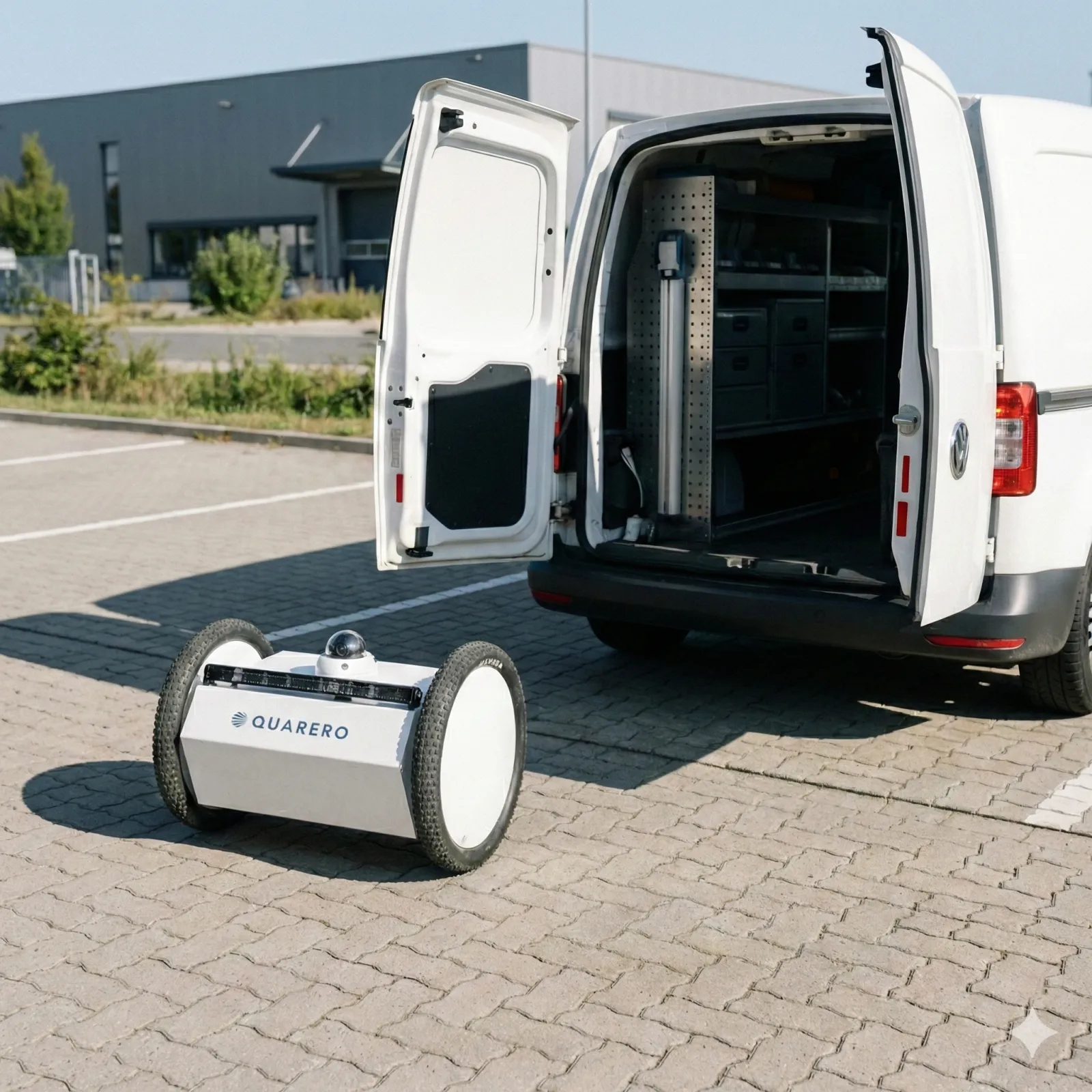
The security robot that pays for itself.
Quarero QR-2 Mk1: an autonomous outdoor patrol robot for industrial perimeters, logistics yards and KRITIS sites. €3,500/month, 48-hour delivery, 14-day free demo. European-engineered Robotics-as-a-Service.
- Patrol
- 24 h
- Sensors
- RGB·THM·LiDAR
- Speed
- 8 km/h
- IP rating
- IP65
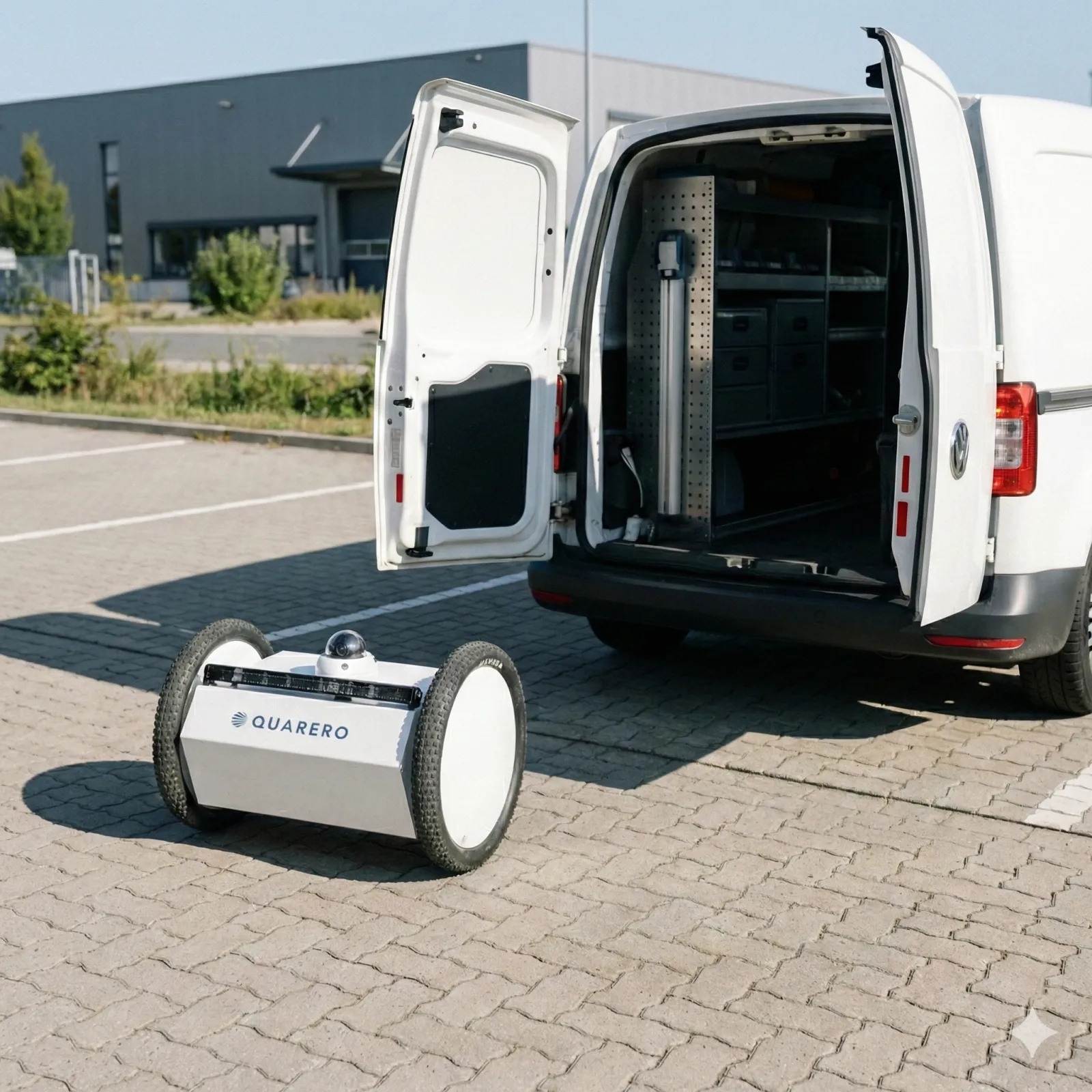
Definition
A security robot is a mobile autonomous patrol platform with on-device AI classification.
Mobile not fixed. Outdoor-rated not indoor-only. AI-classifying not just recording. Edge-compute not cloud-relay. Quarero's QR-2 Mk1 is engineered around all four — and around European compliance: KRITIS-Dachgesetz § 7, NIS-2 Article 34, GDPR Art. 28, EU Machinery Regulation 2023/1230, EN ISO 13482.
- 01 · Mobile, not static
Programmable patrol route covers an area, not a line. Patrol pattern itself signals presence and deters action.
- 02 · AI classifies in real time
Person · vehicle · animal · weather artefact — distinguished on-device. KRITIS-DachG § 7 reads this as state-of-the-art.
- 03 · Edge compute · TLS uplink
On-board edge GPU. Encrypted detection metadata flows continuously; full-resolution video only on event. No cloud-relay latency.
- 04 · IP65 · 24-hour patrol
Rated for outdoor industrial use. 24-hour patrol envelope on hot-swap battery. Hardware survives DACH winter (-15 °C to +50 °C).
Why this category exists
Three structural reasons guards no longer work in 2026.
- 01Personnel shortage
25,000 unfilled guard positions in Germany alone. 30–40% turnover p.a. The personnel base is missing — a regulatory requirement cannot ride on a shrinking workforce.
BDSW · Bundesverband der Sicherheitswirtschaft · 2024
- 02Cost delta · 3×
A 24/7 two-shift guard model in DACH costs €10,500 to €14,000 per site/month. A Quarero Pro on a 24-month contract is €3,500. The delta funds the rest of the fleet.
Quarero RaaS list price · 2026
- 03Audit-readiness
Guards work from memory. Robots store tamper-proof: AI classification + timestamp + response. KRITIS-DachG § 7 reads the latter as state-of-the-art; the former as legacy.
KRITIS-Dachgesetz § 7
Next step
Three sensor depths. Same patrol logic.
QR-1 Basis €3,200 · QR-2 Pro €3,500 (recommended) · QR-3 Premium €3,800 — all per month, 24-month minimum, ex. VAT. Up to −20% combined volume + term discount.
FAQ
Eight questions, the ones we get every week.
What is a security robot?
A security robot is a mobile autonomous platform that patrols a defined perimeter, classifies anomalies via on-device AI, and escalates incidents to a human operator. Sensor stack typically combines optical (RGB, PTZ), thermal, LiDAR and ultrasonic. Compute happens on the edge — TLS-encrypted detection metadata is uploaded continuously, full-resolution video only on event. Quarero's QR-2 Mk1 patrols up to 24 hours per hot-swap battery and is rated IP65 for outdoor industrial use.
How is a security robot different from a static security camera?
A static camera is fixed line-of-sight; a security robot covers an area along a programmable patrol route. The robot's value isn't just mobility — it's that the patrol pattern itself signals presence and deters action, while AI classifies what the optical sensor sees in real time (person, vehicle, animal, weather artefact) instead of recording everything for retrospective review. KRITIS-Dachgesetz § 7 reads classification-per-detection as the state of the art; static cameras don't satisfy that.
How much does a security robot cost?
Quarero ships three sensor depths: QR-1 Basis at €3,200/month (PTZ or thermal, defined areas), QR-2 Pro at €3,500/month (PTZ + thermal, AI anomaly — recommended), QR-3 Premium at €3,800/month (PTZ + thermal + 360°). All on a 24-month minimum contract, up to −20% combined volume + term discount, all prices ex. VAT. Total cost of ownership is fixed and predictable from day one — no CapEx, no depreciation, no technical responsibility on your team.
How long does a security robot deployment take?
Quarero delivers in 48 hours from contract sign — survey, calibration, route configuration, first autonomous patrol all included. The 14-day free demo carries no contractual obligation: cancel within 14 operating days, pay nothing, Quarero dismantles. The industry norm for autonomous-robot rollouts elsewhere is six to eight weeks; we ship the engineered, integrated stack inside the 48-hour window.
Where do security robots work best?
Industrial perimeters with substantial outdoor footprint (factory yards, logistics centres, lay-down yards), KRITIS sites (energy, water, telecom, hospitals, datacentres, transport hubs), construction sites, solar/wind installations, and special properties with a defined patrol envelope. Above ~200 m of perimeter, robotics outpaces guards economically. Below that, hybrid deployments (one robot + one human supervisor) often work.
Are security robots GDPR-compliant?
Quarero acts as data processor under Art. 28 GDPR. Every contract carries a Data Processing Agreement (DPA) plus a model Data Protection Impact Assessment (DPIA) and signage templates. Biometric identification is disabled by default. Footage without an event is auto-deleted within 48–72 hours. EU AI Act risk classification is documented at deployment. For DACH KRITIS sites the regulatory paperwork ships in the box, not as a retro-fit.
Why does European-engineered matter for a security robot?
DACH KRITIS sites are governed by KRITIS-Dachgesetz § 7 (state of the art, demonstrably deployed), NIS-2 Article 34 (up to €10m fine plus personal management liability), GDPR Article 28 (processor agreement, biometric identification disabled by default, footage retention rules), and the EU Machinery Regulation 2023/1230 + EN ISO 13482 conformity. Quarero ships compliant by default — engineered in Filderstadt, governed in Zug, and the regulatory paperwork is in the box, not a retro-fit project after deployment.
Who is the team behind Quarero?
Founding partner Dr. Raphael Nagel (Tactical Management). DACH: Marcus Köhnlein (Managing Director). Quarero Robotics Deutschland GmbH operates engineering and assembly in Filderstadt near Stuttgart since November 2025; Quarero AG (Zug) is the holding. Press: SWR (Stuttgart, 2026), Stuttgarter Zeitung, Schwarzwälder Bote, Startup Ticker, Protector.