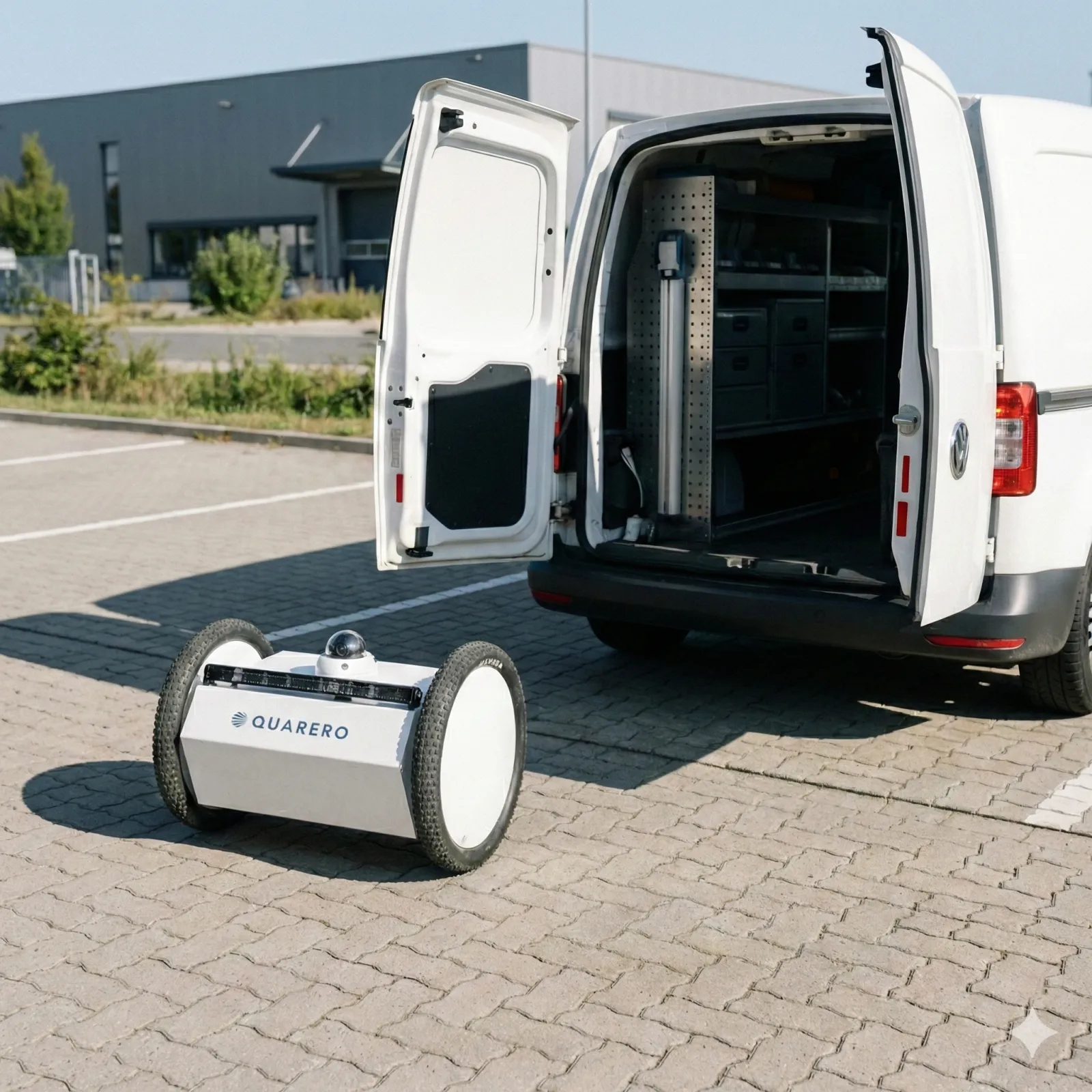
The outdoor security robot that runs through weather.
Quarero QR-2 Mk1: IP65-rated autonomous patrol for industrial perimeters, logistics yards and KRITIS sites. 24-hour patrol envelope on hot-swap battery, on-device AI classification, encrypted TLS 1.3 uplink. Engineered for the DACH winter (−15 °C to +50 °C).
- Rating
- IP65
- Patrol
- 24 h
- Temp
- −15…+50 °C
- Deploy
- 48 h
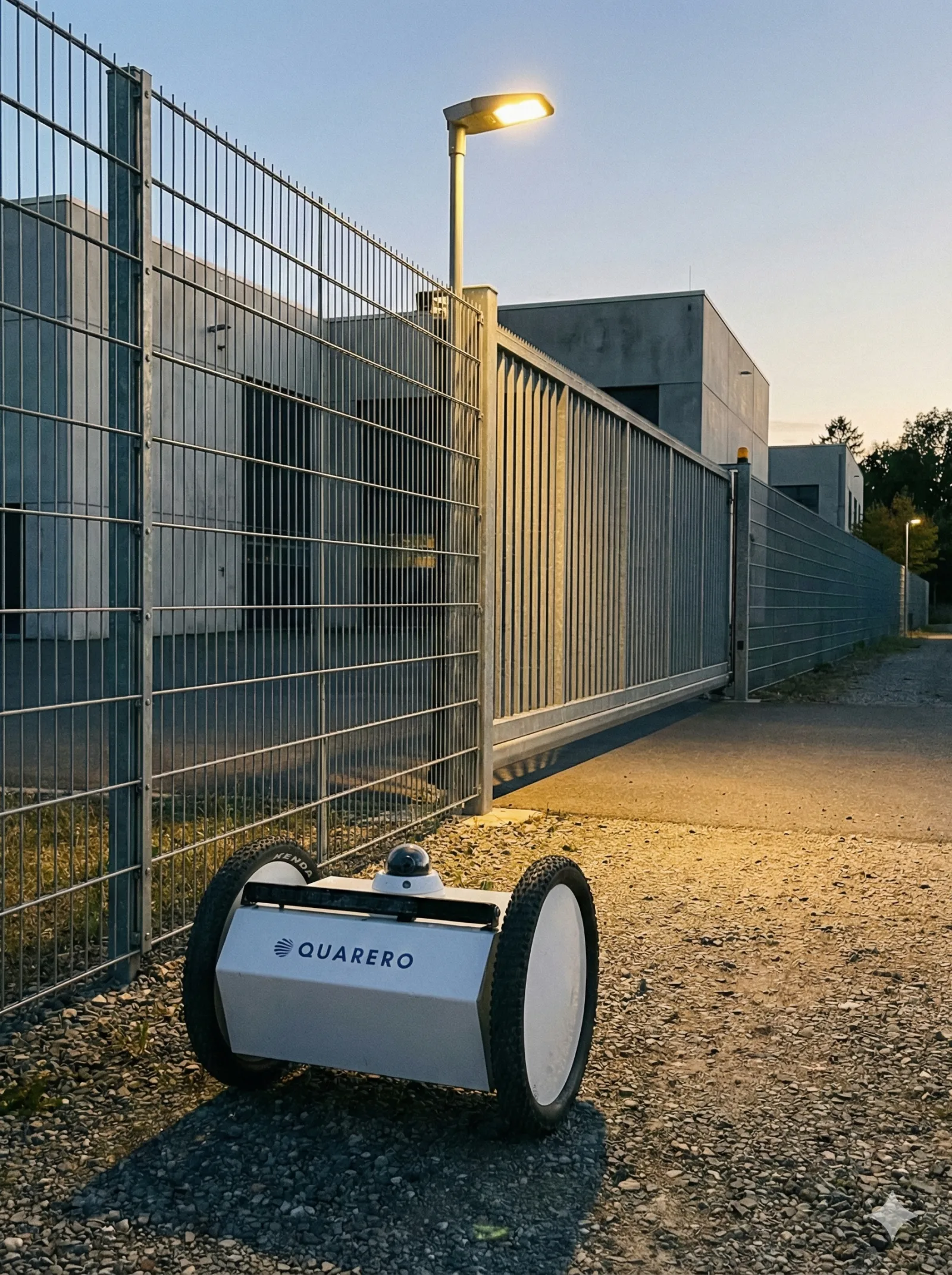
Definition
An outdoor security robot is a weather-sealed mobile patrol platform.
Three traits define the category: weather-sealed hardware (IP65 minimum, IEC 60529), continuous outdoor patrol envelope (24 hours on hot-swap battery), and on-device AI classification (no cloud-relay latency). Below any of those thresholds, the device is an indoor-only or stationary tool — not an outdoor security robot.
- 01 · IP65 weather-sealed
Dust-tight, jet-water resistant per IEC 60529. Survives heavy rain, blowing snow, hose-down. KRITIS-DachG § 7 minimum for outdoor sensors.
- 02 · 24-hour patrol envelope
Hot-swap battery delivers continuous coverage. No return-to-base gap. Effective 24/7/365 with sub-90-second pack swap.
- 03 · Edge AI classification
Person · vehicle · animal · weather artefact — distinguished on-device. EU AI Act-compliant; no facial recognition by default.
Why outdoor matters
Three reasons indoor-rated kit fails on an industrial perimeter.
- 01DACH weather envelope
−15 °C in January, +35 °C in July, blowing snow, horizontal rain. IP54 fails the second digit; IP65 is the documented minimum for fence-line patrol in the DACH region.
IEC 60529 · Schutzarten
- 02Audit-grade AI classification
Outdoor sites trigger 50× more weather noise than indoor (rain, animals, leaves). Edge AI separates real events from false positives in 80 ms — cloud-relay loses 600 ms and the audit trail.
KRITIS-DachG § 7 · Stand der Technik
- 03Personnel base is gone
25,000 unfilled outdoor-guard positions in Germany; 30 to 40 % p.a. turnover. Outdoor patrol is the worst-staffed shift profile in the security sector — exactly the gap robotics fills.
BDSW · Bundesverband der Sicherheitswirtschaft · 2024
Next step
Three sensor depths. All IP65, all 24 h.
QR-1 Basis €3,200 · QR-2 Pro €3,500 (recommended outdoor) · QR-3 Premium €3,800 — all per month, 24-month minimum, ex. VAT. Compare against the US incumbent or read the underlying perimeter doctrine.
FAQ
Eight questions, the ones we get every week.
What is an outdoor security robot?
An outdoor security robot is a mobile autonomous patrol platform engineered to operate continuously outside in industrial weather. Unlike fixed cameras or indoor robots, it carries weather-sealed sensors (RGB + thermal + LiDAR), an edge GPU for on-device AI classification, and a hot-swap battery that delivers a 24-hour patrol envelope. The Quarero QR-2 Mk1 is rated IP65 (IEC 60529) — protected against dust ingress and low-pressure water jets from any direction — and certified to operate from −15 °C to +50 °C, covering the full DACH outdoor envelope.
What does the IP65 rating actually guarantee?
IP65 is defined in IEC 60529. The first digit (6) is the highest dust rating: complete protection against ingress of dust over an 8-hour test under negative pressure. The second digit (5) certifies protection against water jets from a 6.3 mm nozzle at 12.5 litres/min from any direction for at least 3 minutes. In practice, IP65 means a robot can patrol through heavy rain, blowing dust, snow, and direct hose-down without service interruption. KRITIS sites (energy, water, data centres) require this minimum for any outdoor sensor that contributes to the state of the art under § 7 KRITIS-Dachgesetz.
How long can an outdoor security robot patrol on one charge?
The QR-2 Mk1 delivers a 24-hour continuous patrol envelope on a hot-swap battery. The math: a 5.2 kWh pack drives a two-wheel differential drive at 6 to 8 km/h, with the edge GPU and sensor stack running continuously. At end of shift, the operator swaps in a charged pack in under 90 seconds — the robot does not return to base. This gives effective 24/7/365 coverage with no unmanned gap, the operating profile that two-shift human guards cannot match without 30 to 40 % p.a. turnover (BDSW · Bundesverband der Sicherheitswirtschaft, 2024).
Why is an outdoor security robot better than a fixed CCTV camera?
Three structural reasons: (1) coverage geometry — a fixed camera defends a line of sight; a patrolling robot covers an area, so blind spots disappear with motion. (2) Deterrence — a moving, visibly-marked patrol unit cuts intrusion attempts roughly in half versus static surveillance, the same logic as visible foot patrol. (3) Audit trail — the robot stores AI-classification metadata (person, vehicle, animal, weather artefact) per detection event with timestamp, GPS, and full-resolution video on event. Fixed cameras record uniformly and force human review. KRITIS-DachG § 7 reads classified, audit-ready detection as the state of the art.
Is the QR-2 Mk1 compliant with EU regulation?
Yes. The QR-2 Mk1 is built to EU Machinery Regulation 2023/1230 and EN ISO 13482 (personal-care robot safety, applied as the closest harmonised standard for autonomous mobile robots). On-device AI classification falls under the EU AI Act limited-risk category for biometric categorisation; we operate without facial recognition by default, keeping the deployment outside the high-risk Annex III list. Data flow is GDPR Art. 28 compliant: encrypted TLS 1.3 uplink, processor agreement on file, no raw imagery leaves the customer's data perimeter without explicit event trigger.
Which outdoor sites benefit most from a patrol robot?
Five site classes with the strongest ROI: (1) industrial perimeters above 200 m fence length — break-even versus two-shift guard happens in month 1. (2) Logistics yards and lorry parks with high-value cargo and overnight idle. (3) Solar parks and substations — KRITIS energy operators under § 7 BSI-Gesetz. (4) Construction sites with rotating perimeters — robot reroutes weekly without fence works. (5) Data centres and water utilities — NIS-2 essential entities required to prove state of the art. Below 200 m perimeter, a QR-1 Basis on partial-coverage shift still wins on KRITIS-readiness.
How fast can an outdoor security robot be deployed?
48 hours from contract signature to first autonomous patrol. The deployment sequence: day 0 — site survey by remote video walk-through; day 1 — physical delivery in a Quarero van, on-site perimeter mapping with the robot's onboard LiDAR, route definition with the customer's site security lead; day 2 — supervised live patrol, integration into the customer's escalation procedure (alarm receiving centre, on-call security manager). The first 14 operating days are a no-questions-asked free demo: zero euro at risk, full return option without justification.
What does an outdoor security robot cost in 2026?
Three sensor depths under Quarero RaaS pricing: QR-1 Basis €3,200/month (PTZ camera or thermal, single-area coverage), QR-2 Pro €3,500/month (PTZ + thermal + AI anomaly detection — recommended for most outdoor sites), QR-3 Premium €3,800/month (PTZ + thermal + 360° optic + LiDAR). All prices ex. VAT, 24-month minimum, with up to −20 % combined volume + term discount. The two-shift human guard alternative in DACH lands at €10,500 to €14,000 per site/month — the robot is roughly one-third the cost at three times the audit depth.